
Tunnel Time! How Crawl Tunnels Support Baby & Toddler Development
Updated: 4 days ago
Why Crawl Tunnels Are a Favorite Tool for Baby and Toddler Development
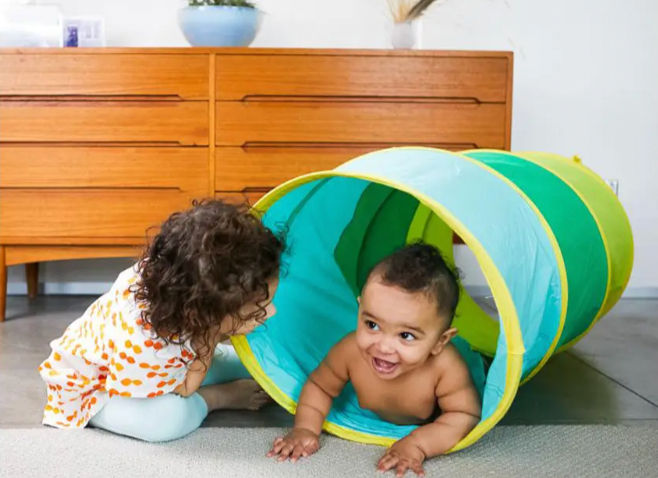
Some of the most effective developmental toys are also the simplest, and crawl tunnels are a perfect example. While they may look like just another play item, crawl tunnels support a wide range of skills for babies and toddlers, including movement, sensory processing, communication, and social interaction.
At Vida Kids Therapy, we love using crawl tunnels because they naturally encourage children to move, explore, and connect — all through play.
Crawling through a tunnel may seem small, but it plays a big role in early childhood development and supports many foundational skills needed for future learning.

Building Strength, Coordination, and Motor Planning
Crawl tunnels encourage whole-body movement that strengthens the core, shoulders, arms, and hips. Crawling requires babies and toddlers to use both sides of their body together, which helps improve coordination, balance, and body awareness. These skills are essential for later milestones such as walking, running, climbing, and even sitting upright for table activities.
Moving through a tunnel also challenges motor planning — the ability to figure out how to move the body through space. Children learn how to enter, turn, crawl forward, and exit, all while adjusting their movements. This type of movement-based problem-solving supports confidence and independence as children learn what their bodies can do.
Supporting Sensory Processing and Body Awareness
Crawl tunnels provide rich sensory input that helps children better understand where their body is in space. As children crawl through a tunnel, they receive deep pressure and proprioceptive input, which can be calming and organizing for the nervous system.
This type of sensory play can be especially helpful for toddlers who seek movement, have difficulty regulating their energy, or benefit from structured physical input.
The enclosed space of a tunnel can also feel safe and comforting, making it a great option for children who enjoy cozy spaces or need help calming their bodies. Supporting sensory regulation through play helps children stay engaged, focused, and ready to participate in everyday activities.

Encouraging Language, Communication, and Social Interaction
Movement-based play creates natural opportunities for communication, and crawl tunnels are no exception. Shared activities like taking turns, waiting, and cheering each other on help build early social and interaction skills.
Parents can model simple, functional language during tunnel play, such as:
“Go” and “stop”
“Your turn” and “my turn”
“In,” “out,” and “through”
Pairing language with action helps toddlers better understand and use words. Over time, children may begin to use gestures, sounds, or words to request another turn, ask for help, or express excitement, supporting early language development and joint attention.
Fun and Creative Ways to Use Crawl Tunnels at Home
Crawl tunnel play doesn’t need to be complicated to be effective. Pop-up tunnels work well, but families can also create tunnels using blankets draped over chairs, couch cushions, or play tents. These simple setups still offer meaningful developmental benefits.
Try building a mini obstacle course by placing pillows or cushions before or after the tunnel, or add a favorite toy at the end to encourage reaching and movement. Turn tunnel play into imaginative games by pretending to be animals, vehicles, or explorers on a mission.
Rolling balls or cars through the tunnel adds visual tracking and turn-taking, while singing songs or giving simple directions brings a language-rich element into active play.
These play-based strategies reflect how therapists support development during everyday routines. To learn more about pediatric therapy services and play-based approaches, visit Vida Kids Therapy at https://www.vidakidstherapy.com/.
A Simple Toy with Big Developmental Impact
Crawl tunnels may seem like a basic toy, but they offer powerful opportunities for babies and toddlers to grow through movement and play. By supporting strength, coordination, sensory regulation, and early communication, crawl tunnels help build the foundation for lifelong skills in a way that feels natural and fun.
When families incorporate simple, intentional play into daily routines, they’re not just keeping their child busy — they’re supporting development, confidence, and connection. Sometimes, the biggest growth really does happen through the simplest forms of play.
For additional information on developmental milestones, visit the Centers for Disease Control and Prevention at https://www.cdc.gov/ncbddd/actearly/milestones. You can also explore trusted resources on sensory play and communication development through the American Occupational Therapy Association at https://www.aota.org and the American Speech-Language-Hearing Association at https://www.asha.org.


Comments